Thursday, July 28, 2011
Moved In!
I've archived about a year's worth of relevant LJ posts by month (that's the only way LJ does it, which is annoying) and other than an omnipresent issues with pictures, it seems to have worked fairly well. There are a few LJ things I will miss (easy time stamping, f-locking posts) but I'll manage. The community aspect of LJ is also something I'll miss, but it's still there (when/if LJ functions) so I'll probably continue puttering around there a bit.

That's it, LJ...
I'm done with your Russian spam and 4-day near nonexistence. I'm moving back to blogger.
Tuesday, July 5, 2011
Lots of stuff, but very little sewing

I ran the white silk through an hour-long dyebath using a little more than the recommended amount of dry dyestuff (Dharma Sapphire Blue Acid dye). Unfortunately, it wasn't quite enough, and I didn't end up with the beautiful dark blue I fell in love with in Drew's samples. However, I still find the color (a very clear sort of french blue) to be very striking and while I have enough dye that I could run it through again, I'm thinking that I might just leave it as-is. The dark blue was a little iffy to document for the particular look of the 1560s, where gowns that aren't black seem to be pretty light colored. I also found that iron-drying damp silk makes it *very* stiff, which is hopefully good news for all the couching I'm going to end up doing.
At FP last week Owen brought a bunch of costume jewelry pieces to sell on behalf of a local former scadian, and there were a few things I couldn't resist getting:

The cross belt will work really nicely as is with my 15th century kirtle, and if I really wanted to, I could probably add spacers to it to make it a nice girdle belt.

And I found this awesome brooch! The stone in the center (most likely glass) is a smokey blue color.


And in my neverending quest for cool time pieces, I found this great little watch face. It'll make a great end for a girdle belt, but I'm still trying to figure out how to change the battery. Hopefully I'll figure something out.

I'm working on some new SCA heraldry with a Magpie and three cinquefoils, so when I saw this piece I had. to. have. it. It's a little more junky than the brooch and other pieces, but the design was inspired, so I went for it.

The seller also had a bunch of handmade bobbin lace, and I snatched about two and a half yards of this lovely stuff. I'm thinking I might be able to work a simple cuff on my 1560s project.
Also, my zibillini came in from etsy!

It was originally a vintage 3-pelt mink stole, but I was able to pick apart the stitches without too much difficulty. I love the silvery color they have going on. I'm intending to give one to Aine to make a prize for the Insurrection A&S tournament, but that still gives me two to play with. They aren't huge (maybe 16" long with the tails) so they should be pretty manageable on a belt chain. PLUS, they were purchased before I heard about the ACC challenge, so they qualify as stash.
Of course, these were all *last* week's accomplishments. The 4th of July weekend was spent visiting Drew's family in Rocklin, and while there was no sewing whatsoever, I had a lot of downtime and so avoided being completely useless:

Here is my first attempt at pearl knotting, using stash freshwater pearls. Unfortunately, Hobby Lobby only sells silk beading cord in 2 meter cards, so the size of my piece is somewhat limited, especially since I made an unsuccessful buttonhole loop on one end (I ended up just tying the ends into 8-pearl loops). I'm hoping to do knotted pearls for most of my jewelry for my project (in keeping with the Margot portrait), though I will need bigger ones for the necklace and belt (budget-wise, I might have to make do with what I have). Some of the knots are kind of funky but I think the overall look will be nice with some practice. I'm hoping this sample will work reasonably well for a hairpiece.
Wednesday, June 22, 2011
LJ Archives: June 2011
June 22: ACC: Fabrics
My stash is pretty close to depleted, but I was able to pull all my fashion yardage from what I already have:
While this qualifies as stash, it's my newest purchase. I got it at a Hancock sale on Saturday ($5/yard!). It's a linen herringbone twill. It's wonderfully soft and floaty and will go toward a smock and probably also a partlet. There is also a japanese kosode in the works which will probably take the remainder of the bolt.

My corset is wearable so I can start fitting the dress but still needs several hours worth of work binding the bottom edges. There is enough gold silk to make bias tape for those edges, and I'm hopeful that there will also be enough to put some guards on a petticoat. The linen fabric on the right was originally yellow until I threw it into a blue dyebath, and now it's a great shade of foresty green, which will be really fun with the magenta corset fabric.

I had a picture of the blue on an earlier post, but here's a flash shot to give a little better idea of the color. The original fabric is a sort of creamy white in a kind of funny mystery weave (not quite taffeta, but not really anything else), but it's 100% silk, takes dye like a champ, and has a really nice crisp finish with a decent lining. There's enough to have some white silk to make the shoulder puffs, and maybe even to line a few things. My white kirtle is the undyed version of this fabric, and it was actually quite easy to work with.

For the ropa/overgown I decided to finally use this rayon velvet that was probably my first big fabric splurge (I bought 10 yards right after I graduated college; it was only $4/yard). It's a beautiful deep mulberry color that shines when it catches the light. I also have 20 yards of gold metallic bobbin lace (half bright gold, half antique gold) to trim it. While it might not coordinate perfectly with the dark blue gown, it'll look smashing with some other stuff I have (like my white kirtle). I foresee this fabric being a nightmare to work with, and much hand-basting in my future.
There are still little bits that I might not be able to pull from stash (canvas, linings, etc) but I'm pretty hopeful that the cost will be minimal.
June 21: Artemisian Costuming Challenge
So the call has been put out in our area for a challenge similar to the one started by Realm of Venus recently, except it's open to any time period or locale used in the SCA. Since I had a brilliant idea for a gown anyway, I decided to join in. The challenge includes making the following between now and the end of the year:1. A skin layer: for this I'll make a square-necked linen smock/chemise, possibly with some embroidery around the neckline, and a green linen petticoat made to coordinate with my corset (hopefully). I'll also finish my corset to wear along with it, though it might not count for the purposes of the competition.
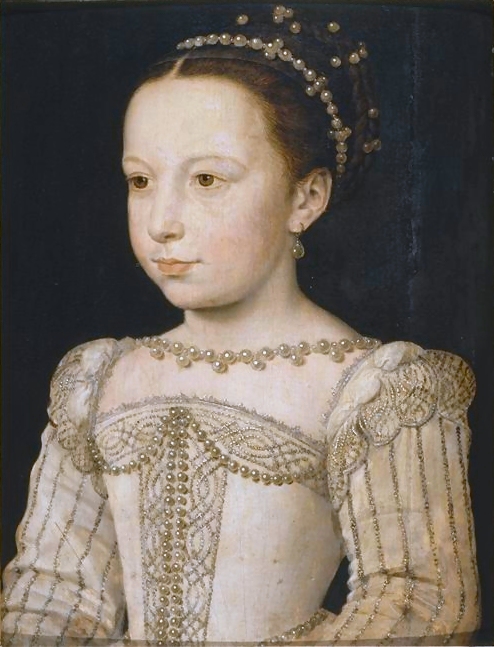
2. The main garment: This will be a blue silk gown based on the portrait of Margot de Valois with silver (yeah, I decided on the silver) couching.
3. An outer layer. I'm much more iffy on this (my whole point with the original gown was that I wouldn't need the extra layer) but if it's doable after everything else is done, I'm thinking of a loose gown with a high neck, similar to this one worn by Margot's sister Claude:

It's very similar to portrayals of Italian zimarra, so I might take some cues from that angle. I have no idea what it will be yet, because there's nothing in my stash that would work for it. Hastings recommended a dark purple fabric lined in pink, which sounds fantastic with a heavy satin and linen, but we'll have to see.
4. An accessory. Any number of things can apply to this, but I'm thinking anything from the following: a zibellino (probably with a lot of help from Holly), a partlet, stockings, tablet woven garters, a feather fan, etc.
There is also a price limit of $100, but stash materials can be used. I can actually cover quite a bit from my stash, but I'll still need a lot of notions and shiny bits.

The photo barely does it justice. I just stared at the sample scraps longingly before I turned my sights to the entire bolt still left over from both of our projects. It turns out we still have over 8 yards, which demanded to be turned into a blue gown, so I called dibs.
I thought about doing a new Tudor, but the silk itself has a pretty soft drape, and even with the dye job giving it a crisper, more taffeta-like finish, I wasn't sure it would play well with the big sleeves of a typical tudor gown. Besides, I already have one of those in the works.
So I went a little later, to the work of Francois Clouet in the 1560s, and I found this portrait of Margot de Valois as a small girl:

And there it was. The dress that I must now have. The work involved tailoring-wise is pretty simple compared to my other projects -- there's really only one visible outer layer, and I don't even need a petticoat if I don't feel like having a split skirt in the front (and I'm thinking I don't). The sleeves are simple other than some classy embellishment and unique shoulder treatments, which are not huge and bulbous like what you see in England, nor are quite as crazy poufy and/or complicated like what you'd find in Italy.
Adult women wore this stuff too:

Claude de Châteaubrun de Beaune dame de Gouffier, by Francois Clouet, c. 1560s (and yes, there are plans for a zibillino too, now that I can finally succumb to that particular fad)
My big internal conflict now is trying to decide if I want to do the embellishment in gold or silver. Gold seems to be standard for just about everything in the period, and jewelry-wise it would look really great with the pearls. Silver is used occasionally (it's certainly on Margot's gown), would be better suited toward my heraldic colors, and would be really eye catching couched on the blue. Using both at the same time seems cheesy. Decisions, decisions.
June 8th: I did a Thing!
Noelle asked if I could make her some garters for when she becomes a Laurel at Baron's war (big prestigious award in the SCA for historical arts), and gave me free reign over the design, so I decided to do not one but two techniques that were completely new to me: brocading, and warp twine manipulation. I'm playing a little fast and loose with specific time periods and places (though all of them are within the medieval period), mostly because I'm using design elements that are especially significant for the recipient. It's woven with a Kanagawa 1000 denier silk that Noelle purchased and sent my way.


The fleur-de-lis and leaf vine (reminiscent of laurel leaves, yes?) are from Ecclesiastical Pomp and Aristocratic Circumstance, about the 13th and 14th centuries maybe (I don't feel like checking right now). The vine was originally for 13 cards and was sized up to work with a 25 card band, but the fleur (which is 17 cards wide) was alternated between sides to fill up the space.

The brocading worked fabulously, even with my wonky tension at the beginning. This portion is for the tails of the garters, which are 5 fleurs long, or maybe 3-4 inches. It's done with a Kreinik gold braid.
I was so tempted just to do the whole thing in this brocade pattern but it's really slow and the gold braid makes it a little stiff and potentially pokey.

The main body of the garters are the warp-twined laurel leaves. I can't capture it very well because the effect is very subtle, but the design comes about by turning the relief backwards and the rest forwards. This technique was in Peter Collingwood's Techniques of Tablet Weaving and is document-able to the 10th century. It's also pretty slow, but I get a lot of satisfaction of splitting up the pack and turning them in different directions.
I'm maybe six inches in, and have 36 or so more to go.
Sunday, May 15, 2011
LJ Archives: May 2011
May 15th: New Project: Effigy Bodies
I started this corset ages ago, before I really got my butt in gear to finish my blue kirtle.
It's fully boned (though I suspect I'll pull some bones out of the back) with cable ties, and is made with two layers of duck canvas. There are only a few tabs cut out now, but I will cut out a few more later to keep it from fraying too much.

And here it is with the silk taffeta outer layer pinned in place. It looks very similar in color to the last picture, but it's actually a really great magenta color. Since this silk was from a thrifted skirt, I had to split the large front pieces more or less in half.

I also wasn't super happy with how the front was connecting to the side back seam when sewing it by machine, so I'm handsewing it in place. I'm not entirely worried about making it look pretty because I'm planning to cover it with a decorative satin stitch that matches the binding.
Which will be this:

Bianca had several large pieces of this gold silk lying around, some with the bias already marked, which was awesome, considering the trouble I had finding any at the fabric store.
Yay progress!
May 15th: Kirtle Progress: Tablet-Woven Reinforcement
To do the braid around the neckline and lacing edge of my kirtle, I used a simple setup of 2 cards with an SZ twist, with all blue thread that matched the fashion fabric of the dress.
The cards were turned in a continuous forward motion, which built up a lot of twist in the unused warp threads. I wanted to have the 'switch' to happen at the halfway point at the CB seam, which involved untying the end and combing out the twist. After the halfway point the cards were switched to backward turns.

Instead of using a shuttle, I just used a needle threaded with the weft thread (the same 1000 denier silk as the warps). I used the needle to beat the weft, and then sew it down to the edge in a circular, whipstitch motion.
Note: This process KILLS the weft thread after about two inches of work. I had to use very small sewing lengths. It's also not great for your fingertips and fingernails, which will get pressed on and scratched up.
Also note that in this picture I used the backstrap method to tension it (the warps are tied to a belt around my waist). I don't recommend it. After a while you won't be able to reach your shed. This happened to me, so I set up two fixed points with a doorknob and a table leg.
Also, I about wanted to kill the little hummingbirds on my protege belt, the pointy little devils.

The flash kind of ate this shot, but you can see how it turned out. You end up with something very much like a herringbone braid that sits not really on either side of the dress, but on the very edge between the layers.
I worked this while the front seam of the skirt was still open, which worked out really well. Corners were kind of a monster, but I found that if you work a little weaving after you hit the edge but without attaching it, you could work up a little 'slack' and sew it onto the new edge after the corner. No pictures of it, sorry (it's very hard to convey what I want a picture of to my husband, and taking it myself just isn't going to work). I'll try to explain it better when I teach it.
The dress is currently hanging up, waiting patiently for gravity to do its thing before I sew the hem.
May 13th: More Tablet weaving Crazy
It seems that when most people do tablet weaving they use something like this:
It's decent. The design dates to something like the 1930s and Angie seems to always burn through her tension bar, but it's much more portable than something like this:

These setups are pretty cool, and conceptually it's the only way to do the crazy warp-sewn braids like what I did on my blue dress (for the class I'm going to try to have the cards threaded between two clamps on a table), but even if you make it collapsible, it's not exactly portable in the grab-and-go sort of sense.
But there is a light at the end of the tunnel:

Box looms.
Technically the figure here is doing narrow rigid heddle weaving, but it can also be used to good effect with tablet weaving. The problem is trying to find one that can go double-duty. While this one from Spanish Peacock looks awesome, it doesn't look like they're offering it right now, and there are a few other sellers/SCA merchants that look to offer something similar in the 200 dollar range, though they all seem a bit too short to get a good shed. Alternately, there are directions available to make one from scratch, which is beyond my capabilities (I need another sub-hobby like a hole in my head) but not beyond those of someone really awesome and talented.
Perhaps someone as awesome and talented as my mom.
Did I mention that my mom is awesome? And occasionally reads this blog? And has woodworking tools? And loves me so much?
May 10th: KA&S and Tablet Weaving
Kingdom A&S was pretty tiny this year attendance-wise, and since pretty much all of the attendees were either entrants or judges, there wasn't much going on in the afternoon. The fabric sale fundraiser seemed to work pretty well, but it seemed all of the good stuff disappeared right off the bat, so I didn't get anything. My blue dress was only lacking a hem, and I need to finish pressing that and do it so I can get some decent pictures, but it got decent scores -- I don't remember the rank it got but it scored somewhere around 35-39 on average (out of 50). My embroidered coif got masterwork level, which was pretty awesome since I have a lot of "this old thing?" feelings about it at this point (all of the scores were in the 40s). Even sans hem, I wore the dress later in the day and got a ton of compliments on it, including one from Elizabeth lamenting that mine was bluer than hers (and next to her she looked navy). Win! Everyone was also super impressed with the warp-sewn tablet weaving I did around the neckline -- if we go to Uprising (kind of up in the air right now) I think I'll try to teach a class on it.
I really should get more photos of my completed work. It's kind of embarrassing.
Tablet weaving is on my mind lately. A gal on

16th century silk brocade with tablet-woven edge
Philadelphia University Design Center (via A Fashionable Excuse)
I mean, I know that tablet weaving was done in the 14th, 15th, and 17th centuries, but I'd never quite made the connection that it was still kicking around in the 16th. Plus, I got a ton of compliments on the hairtie I wore to KA&S (a very simple pink-and-white striped design in silk thread). So...there might be more tablet weaving in my future. Especially since I just ordered this and this for my birthday. Yay me!
Friday, April 15, 2011
LJ Archives: April 2011
April 15: *No Subject*
Thinking once again on the lovely blue and gold (now blue and white) number I'm 2 years into based on this inspiration piece:

I figured out a passamenterie technique that would be very similar to the one used on the neckline trim, thanks to the passament class at Collegium. I'm thinking I could probably make something nearly identical using silk and maybe even some metal threads.
Awesome!
I'm hoping to take some pictures tonight, but my 15th century bodice and 15th century skirt have come together to make something remarkably kirtle-like. I went digging for the sleeves that I cut out ages ago and THEY WERE NOT TO BE FOUND ANYWHERE!!! I hate my lack of space and organization ability when it comes to my fabric and sewing needs! Since I was mad and impatient I cut out some new ones -- I had a 1/2 yard leftover from cutting out the skirt AND my original paper sleeve draft handy, so I guess I was meant to stupidly lose it. If I had planned on long sleeves, I would be completely fuming now, but as it is I can sort of wave it off. They're all pinned together waiting for my lunch break so I can start sewing them together.
I have a feeling that the original sleeves will turn up in about a month and I'll have to make a sleeve-shaped bag or something. I think it would be fitting punishment for going missing.
April 4: *No Subject*
Last night I got so sick of blue fabric I decided to start mocking up my next project: a recreation of Saint Birgitta's Cap from the Birgittine Convent in Uden. It seems that I always miss the best costuming memes by about two years, and this is no exception -- it seemed to be popular with recreationists a few years ago. I don't blame them -- the existence of an extant garment and plenty of corroborating evidence in artwork of the 13th-14th centuries makes it really easy to document.

My library doesn't have Medieval Clothing and Textiles 4 (they only have volumes 1-3, and Interlibrary Loan is dragging its feet) but I was able to find a very partial version of it on Google books with the approximate pattern, so I was able to make my version look more or less like it. Since it's just a mockup, I used a cheapy puple poly-cotton blend and some ribbon that was only long enough to go around the head once.
These pics were taken over some fairly severe bed head, so cut me a little slack.


In the photos it looks a little small on top and a little big in the back, but it felt great. the ribbon coming around the crown gives it a nice tightness and kept it on my head for hours. I think it just needs minimal tweaking from here.
In the photos it looks a little small on top and a little big in the back, but it felt great. the ribbon coming around the crown gives it a nice tightness and kept it on my head for hours. I think it just needs minimal tweaking from here.
The extant cap is 14th century, technically a bit earlier than the blue kirtle I'm working on, but the style seemed popular for over the 13th and 14th centuries and doesn't seem to be unheard of as late as about 1475 (http://special.lib.gla.ac.uk/images/chaucer/H252_0186rwf.jpg). Also, it seems really useful as a foundation for attaching further headgear and veils, which is still a valid need in the 15th century.
The attachment mechanisms for this cap seem pretty similar to those of coifs of the Elizabethan era (http://www.extremecostuming.com/articles/howtowearthecoif.html), so much so that I wonder if one style didn't just lead to another over time, but that's research for another day.
it's feeling that way, anyway. 12 gores was just a tad ambitious. I was really hoping to get the whole dress finished by the end of March, but I've been languishing on this skirt. I made a lot of progress over Conference weekend, and it's at least now recordable as something resembling a skirt. The final hem looks to be maybe 5/8 of a full circle, which is pretty good considering I used about 4.5 yards of fashion fabric. I did some math that led me to believe the hem will be about 200 inches, and even if that's generous, that's still a pretty full hem. Awesome!


The attachment mechanisms for this cap seem pretty similar to those of coifs of the Elizabethan era (http://www.extremecostuming.com/articles/howtowearthecoif.html), so much so that I wonder if one style didn't just lead to another over time, but that's research for another day.
April 3: Kirtle Progress: Skirt of Death
it's feeling that way, anyway. 12 gores was just a tad ambitious. I was really hoping to get the whole dress finished by the end of March, but I've been languishing on this skirt. I made a lot of progress over Conference weekend, and it's at least now recordable as something resembling a skirt. The final hem looks to be maybe 5/8 of a full circle, which is pretty good considering I used about 4.5 yards of fashion fabric. I did some math that led me to believe the hem will be about 200 inches, and even if that's generous, that's still a pretty full hem. Awesome!
I was a little worried about doing a true pinwheel technique on this instead of doing something more symmetrical to the right and left sides, but it was a lot easier to sew it straight-to-bias with my particular sewing method. Plus, there will be no weird stretching along the seams.

The technique seems a lot more obvious on the reverse side. I haven't quite finished tacking down all the seams yet (you can see the 3:00 seam still needs the treatment), but I've gone over a major hump with this. There are probably 50 hours in that skirt, easily.
And my poor sewing finger laments! Thimbles seem to just slow me down, so I just deal with the needle pricks.
Thursday, March 31, 2011
LJ Archives: March 31, 2011
March 31
Best. Fantasy dress. Ever.
Ellen Terry as Lady Macbeth in 1888

Her costume on display after intense conservation work.
Beading a dress with thousands of actual beetle's wings is just a step beyond. The Victorians didn't mess around.
If I had any occasion to wear fantasy stuff, I'd be all over this.
Subscribe to:
Posts (Atom)